
Custom car sound deadening FAQs
Consult GCI custom car sound deadening specialist
Any questions about custom car sound deadening
As a leading manufacturer who focused on Mid-to-High-End automotive sound deadening solutions, GCI AUDIO, founded on March 8, 2008, is a comprehensive manufacturing group integrating R&D, product design, production, sales, and global export. GCI headquartered in Guangzhou, China, GCI AUDIO operates a modern production base through its subsidiary Foshan Xingyuanda Technology Co., Ltd. (established in 2015).
We are a Chinese top car sound deadening mat manufacturer and our factory is located in Foshan. Our Foshan sound deadening factory covers over 6,000 square meters and is equipped with advanced production facilities, including high-value internal mixers, extrusion machines, laminating machines, printing equipment, and cutting lines. Welcome to visit our factory!
We have passed ISO 9001, CE, Reach, RoHS, SGS and other certifications, and meet the mainstream standards of Europe, America, the Middle East and Asia.
GCI founder, Ellien, a visionary with over 20 years of deep-seated expertise in the automotive acoustic industry.10-person R&D team (5 senior engineers) + 50-person production team, with an average of 8 years of experience and 100% certification rate.
Asia (Japan, South Korea, Southeast Asia), Europe and America (Germany, the United States, Canada), the Middle East (UAE, Saudi Arabia), and more than 50 countries.
We specialize in the development and manufacturing of mid-to-high-end automotive vibration damping, sound insulation, sound absorption, and thermal insulation materials, providing comprehensive solutions for vehicle noise control and audio upgrade applications.
10 set
We support custom extrusion products. The usual process has 4 steps: demand confirmation → 3D design/proofing → test certification → mass production (cycle 3-8 weeks).
3 days for stock materials, 7-10 days for new formulas (including performance test reports)
We can send them to SGS/Intertek and other institutions, and the cost is borne by the customer (about $300/item).
The price is determined by the quantity, material, processing method, size and other factors. In addition, due to our continuous technological innovation, the prices of some of our products are extremely competitive, please contact us to quote.






“Our SPL build needed to eliminate door panel resonance at 158Hz without adding mass. GCI’s laser-vibrometer analysis identified critical nodes, and their 0.8mm viscoelastic patches killed vibrations completely. The pressure-sensitive adhesive survived 160dB bass tests. We are very excited that our clients have achieved better racing rankings as a result.”
Kenichi
Purchasing Director


Find answers of custom car sound deadening
Thanks to our excellent management system, all the custom car sound deadening are controllable.
What is custom car sound deadening
Automotive sound deadening reduces noise, vibration, and resonance by treating vehicle metal panels and cavities.
Road noise, engine noise, wind noise, vibration noise, and panel resonance can all be reduced.
Common areas include doors, floor, roof, firewall, trunk, wheel wells, and hood. Covering as much metal surface as possible yields the best noise reduction results.
For optimal results, it’s recommended that about 80–90% of the vehicle’s metal surfaces be covered. Gaps will allow noise to still enter the cabin.
“1. Yes, when installed correctly and not covering airbags, sensors, or wiring.
2. Proper automotive soundproofing products do not interfere with vehicle safety systems, but care must be taken not to cover sensors or airbag areas. Low-quality materials may degrade or emit odors at high temperatures.”
Automotive sound deadening materials help reduce engine, road, and wind noise, significantly improving ride comfort and overall NVH (Noise, Vibration, Harshness) performance.

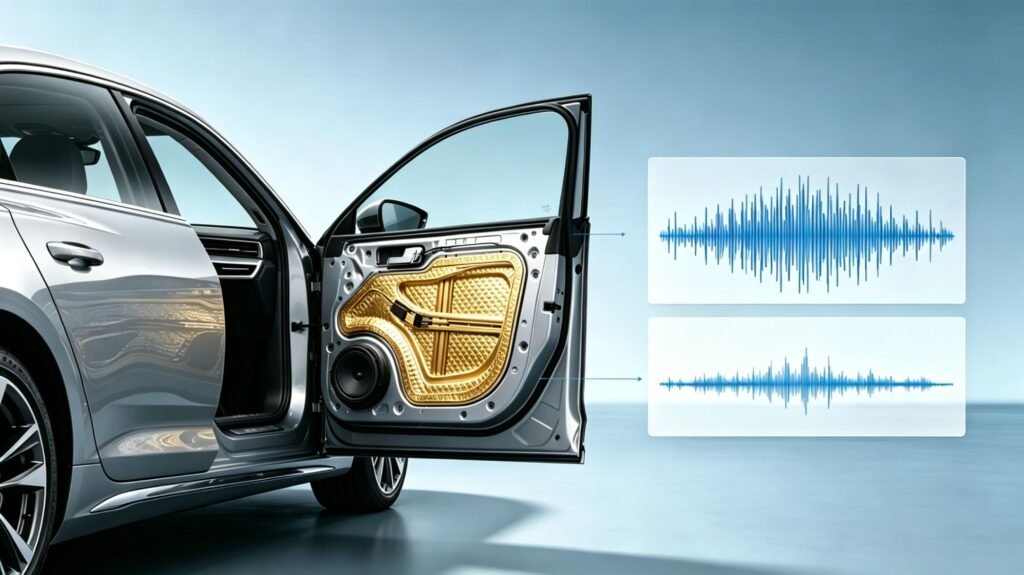
Sound insulation and sound absorption
Vibration damping reduces panel resonance by converting vibration energy into heat.
1. Absorption converts sound energy to heat to reduce echo, while soundproofing blocks sound from entering the cabin; using both gives superior results.
2. Sound deadening controls vibration; sound absorption reduces airborne noise. They work best together.
Some materials provide thermal insulation and help reduce heat transfer.
Damping mats (like butyl rubber) primarily reduce vibration and structural noise; foam materials absorb airborne noise. Combining both leads to better overall results.
How to Choose Soundproofing Materials
Yes, but performance depends on material formulation, density, and application—not thickness alone.
Yes, generally, thicker and heavier materials deliver better soundproofing, but they also add weight. It’s important to balance performance and vehicle mass.
Due to uneven surface structure, thickness varies. Weight (GSM) is a more accurate performance indicator.
Yes, but properly designed materials balance performance and weight efficiently.
Expected noise reduction varies with vehicle structure, materials, and coverage, but many installations can achieve 3–10+ dB reduction, depending on conditions.
Yes, including passenger cars, SUVs, trucks, EVs, and commercial vehicles.

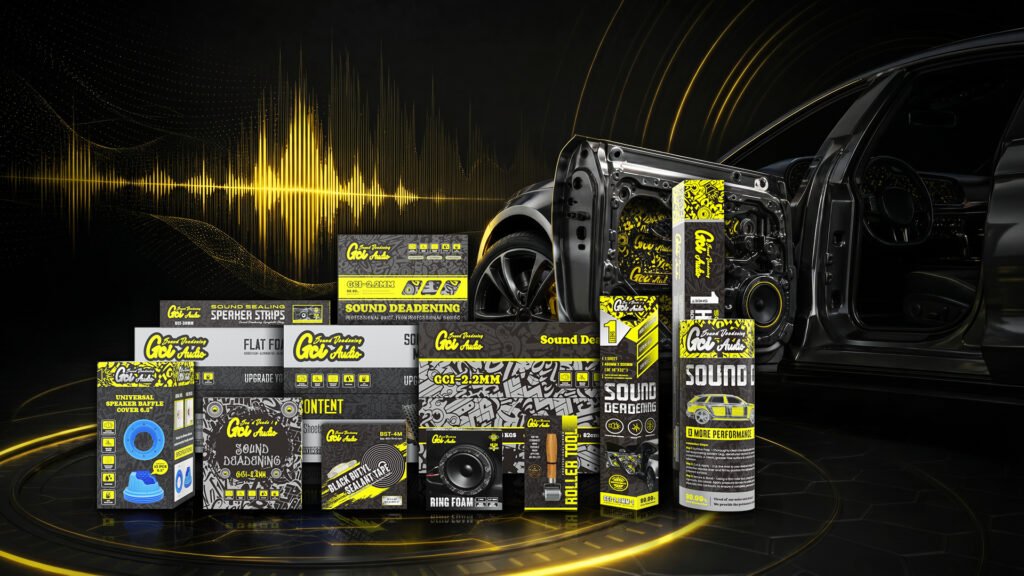
Sound deadening performance
Very important. High-quality adhesive ensures long-term bonding under heat and vibration.
Yes. Inferior materials may emit odor or fail under high temperatures.
High-quality materials can last for many years without performance loss.
Quality acoustic materials should be heat resistant, moisture resistant, and durable under various environmental conditions.
Yes, reducing vibration improves speaker clarity and bass response.

custom car sound deadening
At GCI AUDIO, we believe that quality is the foundation of long-term brand success.
For over a decade, we have supported global brand owners, distributors,and retailers with reliable, market-ready automotive sound system solutions —
not just products, but systems built for long-term success.